· Dana Whitfield
Collapsible snake hooks: what telescoping, stainless and heavy duty actually mean
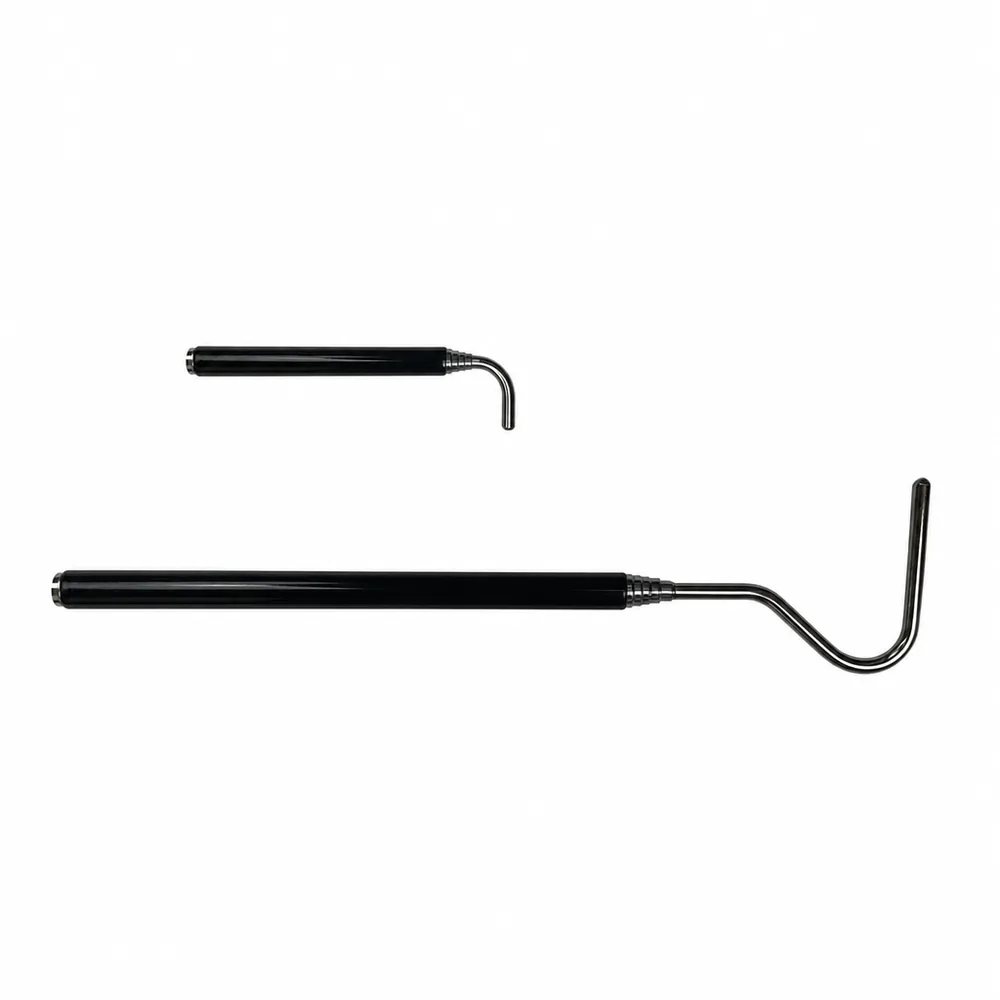
Three words do most of the work in the listings for compact snake hooks, and none of them are defined anywhere a buyer can read them. Collapsible covers at least three different mechanisms. Stainless describes alloys that behave nothing like a painted tube. Heavy duty describes a construction rather than a quality rating, and that confusion is how people end up with the wrong tool. This guide takes each term apart and says what it changes in the hand.
Collapsible covers three different mechanisms
The first thing to sort out is what a hook is doing when it gets shorter, because three constructions share the same shelf and they do not behave alike.
A telescoping shaft is built from tubes of decreasing diameter that slide inside each other. Pulled open, the sections stop against internal shoulders and stay put by friction. Closed, the whole shaft retracts into the widest tube, which is usually the handle. This is the construction with the shortest closed length, because every section disappears into the one behind it.
A folding hook hinges instead. The shaft breaks at one or two joints and doubles back on itself, so a long bar packs down to roughly half its open length. The hinge is a fixed mechanical part, which makes the open length rigid and predictable, and it also means the closed length can never be shorter than the longest single segment.
A takedown hook unscrews. Two or three threaded pieces come apart for transport and screw back together for use. Nothing slides and nothing hinges, so the assembled bar is as stiff as a one-piece hook, but you are carrying loose parts and assembling them at the moment you need the tool.
| Mechanism | How it shortens | What it gives up |
|---|---|---|
| Telescoping | Sections slide inside each other | Needs friction to hold under load |
| Folding | Shaft hinges and doubles back | Closed length limited by one segment |
| Takedown | Threaded pieces unscrew | Assembly time, and loose parts to lose |
Our hook is the first of the three. The specifications and the sizing ladder are on the hook page, and what follows explains what that construction asks for and what it gives back.
How a friction telescoping shaft holds its length
Friction hold means there is no button, no collar and no detent deciding where the shaft stops. Each section grips the one behind it through contact pressure across the overlap, which is why a telescoping hook opens to any length you want rather than to three preset positions. Ours runs through six sections between 7 in (18 cm) closed and 26 in (66 cm) open, and every length between those two is available to you.
Section count is the specification most listings bury, and it decides two things at once. It sets how short the tool gets when closed, since a shaft divided into six pieces retracts further than the same shaft divided into three. It also sets how many usable intermediate positions you have, because each additional section is another place the bar can stop. A hook that only functions at full extension is a fixed hook carrying extra joints.
The question that matters with friction is not whether the sections hold on a bench. It is whether they hold when a snake shifts its weight along the bar, which loads the overlaps sideways rather than straight down. That is the test we run on this hook, described in how we test: extend the shaft, load it, and move it the way it gets moved in a rack. A section that creeps closed mid lift is the difference between a controlled move and a dropped animal.
The habit that goes with the mechanism is short. Pull each section out firmly rather than flicking the shaft open, and seat every joint before the hook goes near an enclosure.
Stainless steel, and what the material decides
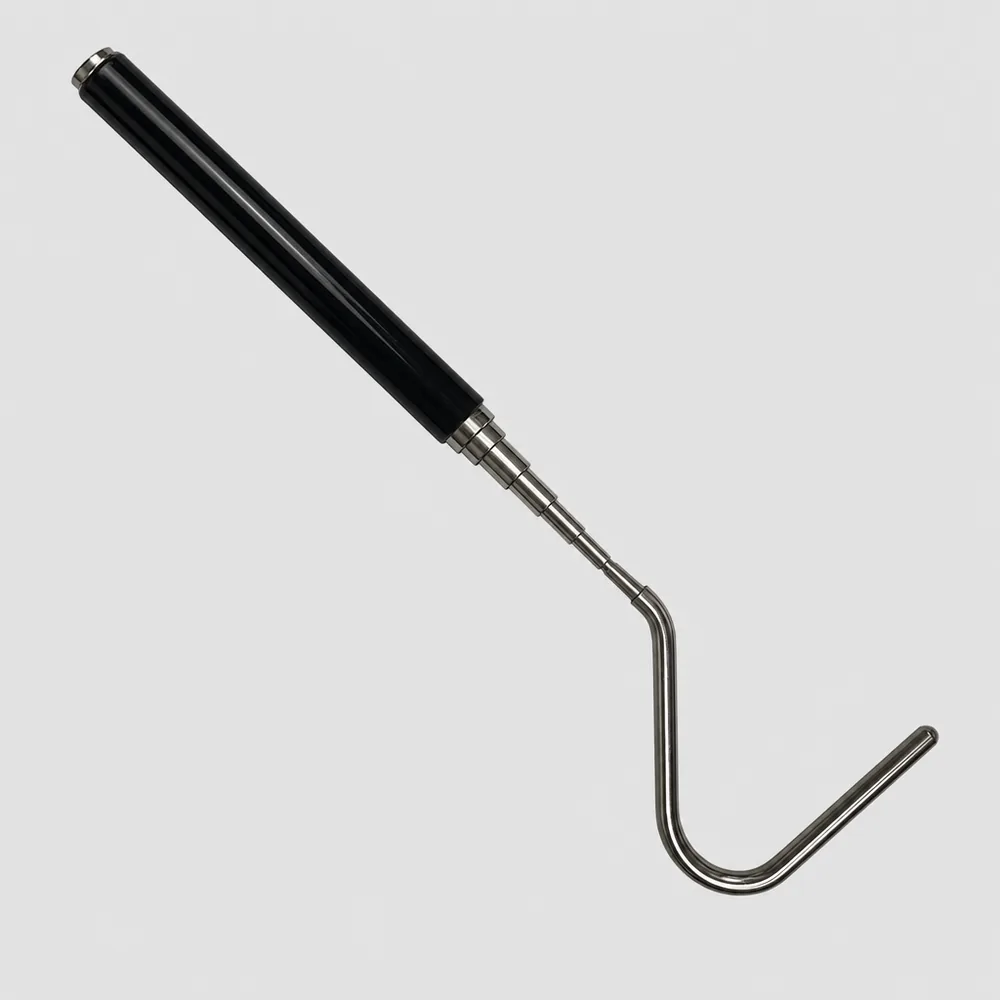
Material choice on a telescoping shaft is not decoration, because the sliding surfaces are also the surfaces you have to disinfect. Stainless steel takes soap, disinfectant and repeated rinsing without pitting, and it absorbs nothing. That is what makes a between-animals cleaning routine possible at all. The full routine, including flushing the overlaps while the hook is open, is in how to clean a snake hook.
The alternatives fail in specific ways. A taped wooden dowel drinks water and holds whatever was on it, which rules out real disinfection. A painted or anodized tube is fine until the coating wears at the overlap, which on a telescoping shaft is exactly where the wear happens, so it goes in the one place you cannot see or scrub. Bare mild steel rusts at the joints, and a rusted joint on a friction shaft either seizes or slips.
Stainless also keeps the sliding fit stable over time. Telescoping depends on a consistent gap between tubes, and a material that swells, flakes or corrodes changes that gap. This is the practical reason homemade hooks tend to be single-piece builds: making a telescoping shaft from hardware store parts is a materials problem before it is a fabrication problem.
The head is stainless too, and its geometry is published rather than described: the curve measures roughly 1.8 by 2 by 2.2 in (4.5 by 5 by 5.5 cm), wide enough for a body to rest across and open enough that nothing gets caught in the bend.
What heavy duty describes, and what it does not
Heavy duty is a construction description, not a grade or a certification. In snake handling tools it points to a specific build: a large diameter shaft, usually fixed rather than collapsible, a head welded rather than formed from the same tube, and a length that starts where compact hooks stop. Those hooks exist for adult boas, burmese pythons and reticulated pythons, and for removal work where a long fixed bar is the point.
Read that way, the term stops being a ranking and becomes a spec. A heavy duty bar is a different tool aimed at a different animal, and it is heavier, longer and impossible to pocket, which are the exact properties that make it right for a large adult constrictor and wrong for a hatchling tub on a shelf.
This hook is documented for a defined range, and we publish the ceiling on the product page rather than leaving it to be discovered: hatchlings and juveniles of any species, corn snakes, kingsnakes and milk snakes at full extension, and ball pythons up to roughly a year old. Adult ball pythons and small boas are workable when you support the animal with a second hand. Above that the ladder stops, and it stops on purpose.
One more piece of the same subject. There is no published weight for this hook, and no weight row in the specification table, because the spec sheet documents material, length, section count and head dimensions and not mass. Weight is the number buyers use to guess at rigidity, and the sizing ladder does that job with measured information.
Closed length is the number that decides whether the hook is with you
Every other specification on a collapsible hook is about how it performs. Closed length is about whether it is present, and presence beats performance every time, because a tool in the garage handles nothing.
At 7 in (18 cm) closed with its black gripped handle, this hook rides in a jacket pocket, a glovebox or a camera bag without a case. That figure turns a hook from equipment you plan around into an object you simply have on you, which matters most on a road at dusk when a snake is crossing. The rest of a kit that survived eleven seasons is in the field herping gear checklist.
The same number pays off indoors for a different reason. Closed, the hook sits in a drawer next to the tubs. Opened part way, it is short and controllable for a hatchling in a shallow tub at eye level. Opened fully, 26 in (66 cm) puts your hand outside the door frame while the head is under an animal at the back of a rack. You are not choosing one fixed length and living with it for every enclosure you own.
That range is also the reason a single hook covers a growing collection rather than becoming the wrong size twice a year.
Folding tongs collapse on a different principle
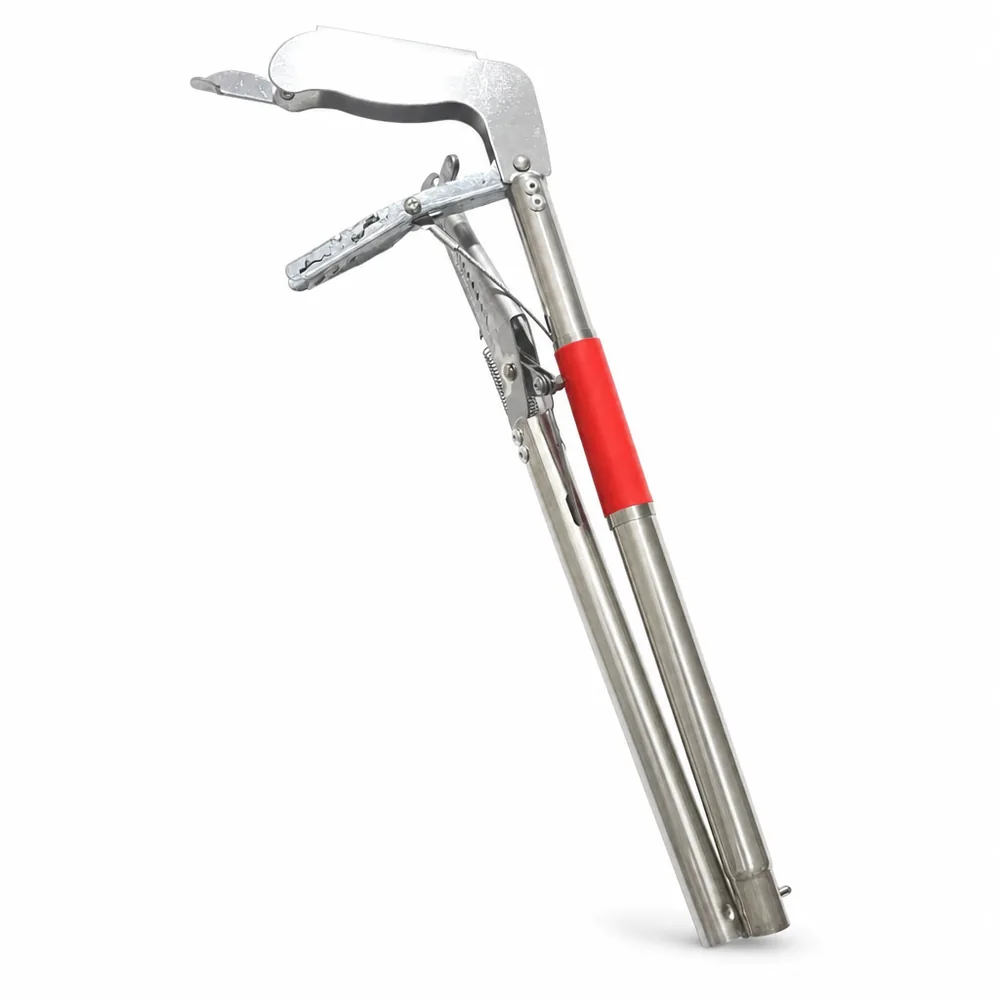
Tongs that pack down do it by sliding rather than by telescoping in the sense used above. On the pair we sell, the body slides into itself through two tubes: 29.5 in (75 cm) from handle to head extended, and a listed 17 in (43 cm) packed, which fits a backpack or the same bag carrying a closed hook. The elbow carries a lock, so the head stays in position rather than drifting, and a full hand trigger drives the jaw against a tension spring. It arrives with a pair of gloves and a mesh bag.
Since this article is about collapsing mechanisms, one point on that pair belongs here rather than in a footnote. Among the written feedback we collect, one buyer contests this exact specification and states that the length does not decrease as stated. That is a single report against a published figure, and we print both side by side. The 30-day money-back guarantee covers the case where a specification turns out to matter more to you than it did to us.
The mechanical split between the two tools has nothing to do with how they fold. A hook supports a snake and tongs close on it, so tongs apply pressure and a hook does not. That is why tongs are for reaching under debris or into a gap a crook cannot serve. The dimensions are on the tongs page and the full comparison is in snake hook vs snake tongs.
What a collapsible shaft asks for in return
A telescoping tool has one maintenance rule a fixed bar does not: everything you do to it, do it open. Clean it, rinse it and dry it extended, and collapse it only once the sections are dry to the touch. Water trapped in an overlap is invisible, and it sits against the one surface the mechanism depends on.
Collapsing and extending the shaft two or three times under running water during a rinse flushes the overlaps rather than pushing debris deeper into them. It takes about ten seconds. Grit is the other thing to watch after a field trip, since sand in a joint acts like a lapping compound every time the shaft moves.
Storage follows the same logic. Put the hook away closed once it is dry, and keep it somewhere it will not sit in loose substrate. In exchange you get a tool that fits in a pocket, which no fixed hook does.
Technique matters more than any of it. Where to place the head, how to lift from the middle third, and how to move an animal without gripping it are in how to use a snake hook.
Reading the three specifications together
Put in order, the three terms answer three separate questions, and reading them together is how you match a hook to a collection.
Section count answers how many working positions you get and how small the tool becomes: six sections, 7 to 26 in, every length in between available by friction. Material answers whether you can disinfect it between animals without destroying it: stainless through the shaft and the head. Heavy duty answers which animal the build is aimed at, and since it describes construction rather than quality, the useful question is what a hook is documented to handle rather than which adjective is on the box.
For hatchlings, colubrids and ball pythons up to about a year, a six section stainless hook that closes to 7 in covers the collection and travels with you.