· Dana Whitfield
How to find an escaped pet snake in your house, and bring it back with a hook
The enclosure is open, the hide is empty, and the water bowl has a dry ring around it. Every keeper gets this moment eventually. The useful news is that an escaped pet snake is a solved problem: it has not gone far, it is in less danger than the household imagines, and it will be found in one of a short list of places. What follows is the search order we use on our own collection, the places that turn up an animal most often, and why the tool for the last step is a hook rather than a hand.
The first ten minutes: check the enclosure, then seal the room
Before anything else, look in the enclosure properly. A snake pushed under its substrate, coiled behind the background or wedged under the rim of the water bowl accounts for a surprising share of escapes that never happened. Lift every hide, run a hand through the bedding, and check the underside of the lid. Only once you are certain the animal is out does the clock start.
Then work out how it got out, because the exit tells you the direction. A lid left unclipped means the snake climbed out over the top and dropped, so it is probably below the enclosure, not above it. A gap at a cable port, or a sliding door that does not meet in the middle, means it left sideways at rack height, which puts it on the shelf or the wall behind. Leave the enclosure open with the heat running: a warm, familiar box with water in it is the best bait you own, and animals do walk back into it.
Now close the room. Shut every door that leads out of it and push a rolled towel into the gap under each one, because snakes travel along walls and leave through openings at floor level. Get other pets out and keep them out: a cat will find the snake before you do, and that is the outcome this whole article exists to prevent. Snakes move in bursts and then settle, and a settled snake in a warm spot can stay put for a long time, which is why knowing where they settle matters more than a frantic first sweep.
Where a loose snake actually goes
A snake outside its enclosure is looking for three things, in a fixed order: something to press against, somewhere dark, and somewhere warm. It follows the baseboard until the baseboard gives it an opening, and it takes the first opening that is tight, dark and slightly warmer than the floor. That narrows the search a great deal.
The warm places in a house are predictable. The back of the refrigerator, where the compressor runs, is the single most common place we have found a missing animal, followed by the gap under the dishwasher or the oven, the cupboard around the water heater, the space behind a dryer, and the back of any electronics cabinet that stays switched on. In winter, add radiators and floor vents; in summer the dark list takes over: couch frames, the toe kick under kitchen cabinets, boots left on the floor.
Species changes the search a little. Colubrids climb: a corn snake or a kingsnake will go up a curtain, along the rod and onto a bookshelf, and it will do it quickly. A ball python is heavier, slower and almost always goes down and under. Hatchlings of any species get into gaps you would not think to check, including the space behind an outlet cover. And check the underside of things: the fabric stapled under a box spring, the dust cover under a sofa. A snake inside a box spring can stay there for days without a sign.
| Where to look | Why the snake goes there | How to check it |
|---|---|---|
| Behind and under the refrigerator | Compressor warmth, darkness, a tight gap | Flashlight along the floor, collapsed hook slid under the toe kick |
| Under the oven, dishwasher and dryer | Residual heat, a gap the width of a snake | Beam from floor level, hook extended to the back without moving the appliance |
| Inside couch and recliner frames | Dark, enclosed, off the cold floor | Tip the furniture, lift the dust cover with the hook |
| Bookshelves, curtains, hung coats | Climbing colubrids go up before they go under | Top of every shelf, fold of every hanging fabric |
| Boots, bags, laundry on the floor | Tight, dark, scented with a familiar person | Pick them up one at a time and look inside first |
| The enclosure, an hour later | Warm, familiar, water available | Leave it open and heated, check it on every pass |
The search: low, slow, and again at night
Search one room at a time and finish it before you move on, starting with the room the enclosure is in. Get down to floor level with a flashlight, because the gaps under things are where the animal is. Sweep the beam along the baseboard, under every piece of furniture and behind every appliance, and look for signs as much as the animal: a clean streak in the dust under the fridge, a shed skin, a shape that does not match the shadow it should be casting.
Go slowly and quietly. A snake feels footsteps long before it sees anyone, and an animal that feels you coming either stays still, which is good, or moves deeper, which is not. Night is when most of them move. Colubrids and ball pythons both travel in the evening and the early hours, so a search late at night with the lights off and a flashlight held low finds animals that a search at noon walked past.
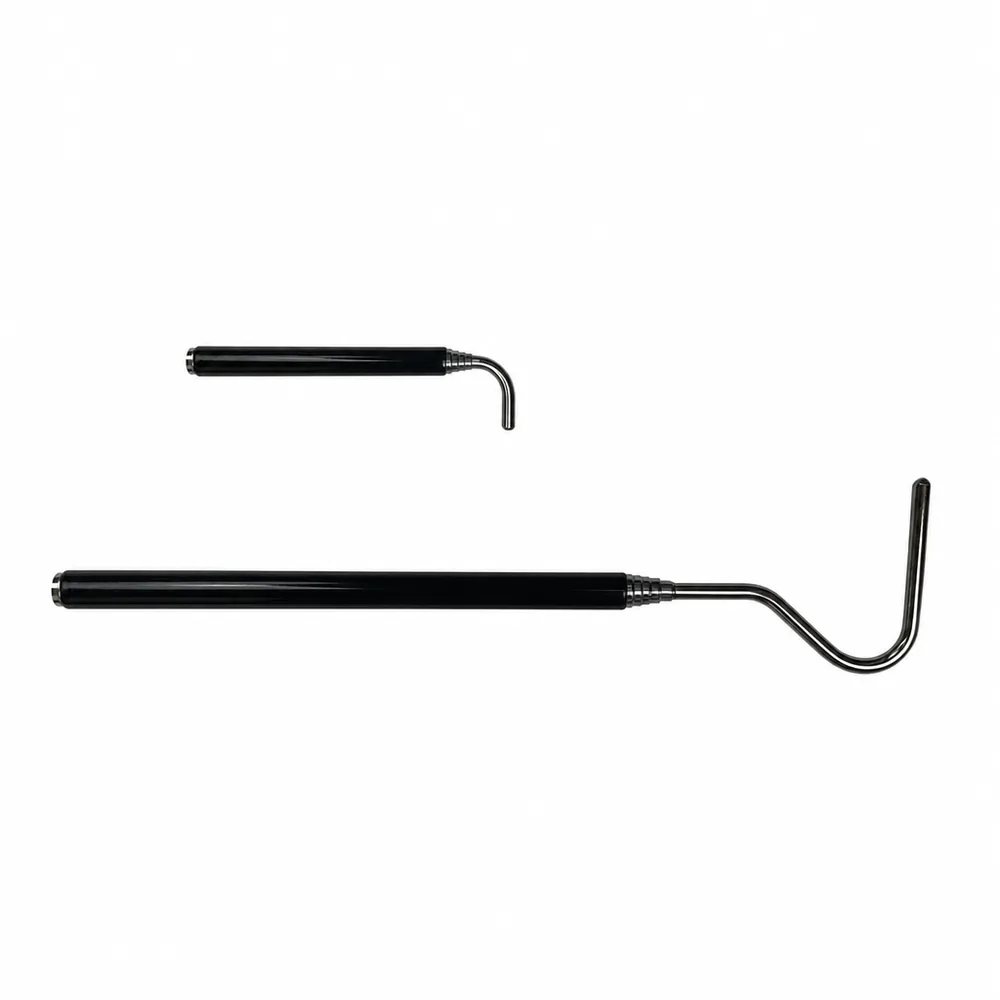
Use the hook as the probe, not your hand. Collapsed to 7 in (18 cm), our telescopic hook slides into the toe kick under a kitchen cabinet or the gap under a fridge that is too low for an arm, and tells you by feel whether something is there. Extended to 26 in (66 cm), it reaches the back of a couch frame from the front without lifting the couch. The shaft goes in before your fingers do: a startled snake in a tight space bites whatever arrives first, and that should be stainless steel, not a knuckle.
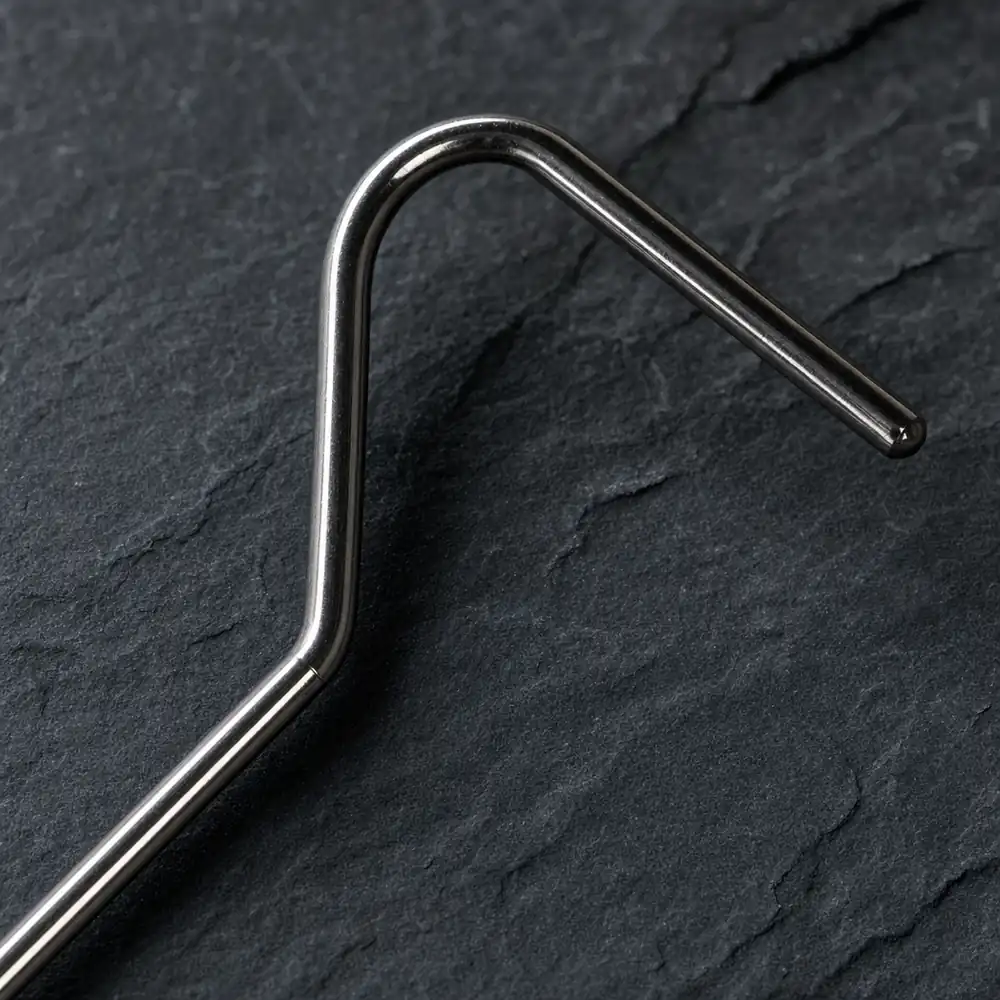
The head shape does some of the work too. A curve measuring roughly 1.8 by 2 by 2.2 in (4.5 by 5 by 5.5 cm) is wide enough to lift a dust cover or a fold of fabric and shallow enough to slide under a snake lying flat in a gap. A blunt stick moves the snake. A curved head gets underneath it.
When a sweep finds nothing: set a bait station and read the floor
A snake that will not show itself in two sweeps needs a reason to come out, and then needs to be caught coming out. The reason is warmth and water. In the sealed room, in a floor corner, set a small tub on its side with a towel inside and a warm surface under it, using the same thermostat controlled heat source that runs the enclosure, never a bare lamp. Put a heavy water bowl next to it, and leave the enclosure open and heated as well.
Then make the floor talk. A thin line of flour across each doorway and along the baseboard records a track the moment a snake crosses it, and the direction of the smear tells you which way it went. Combined with the warm tub, this is how most of the animals that two visual sweeps missed get found.
One warning: do not use the glue boards sold for rodents. A snake caught on one tears its own scales trying to leave, and removing an animal from glue is a job for a veterinarian. And do not panic about food: a healthy adult colubrid or ball python is built to go a long stretch between meals. What it does need to be kept away from is water it cannot climb out of, so keep toilet lids down until the animal is back.
Bringing it back on a hook, not in a fist
You found it. It is coiled behind the dryer or half under the couch, and the urge is to grab. Do not. A snake that has been loose is cool, stressed and wedged, and a hand closing on it either sends the animal deeper into the gap or gets bitten. This is what the hook is for.
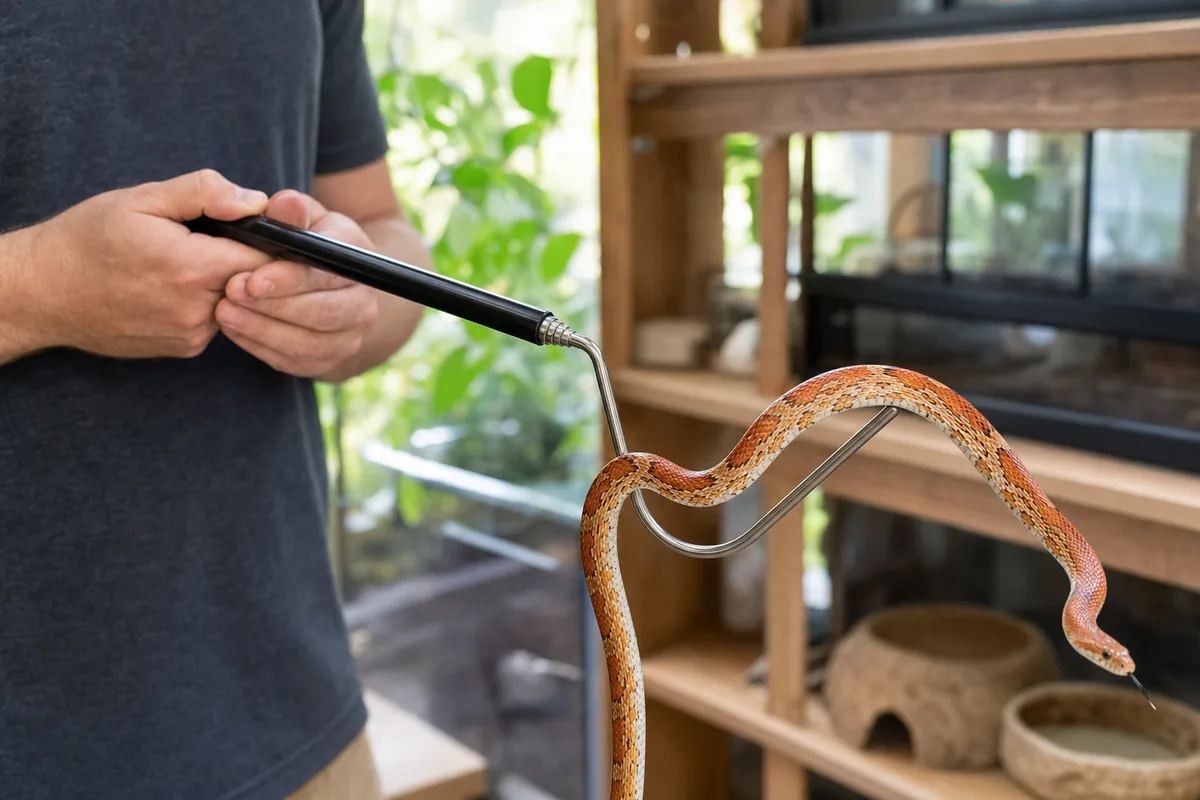
Set the length to the gap, not to the maximum. Six telescoping sections mean you can pull out one or two and reach the middle of the snake from where you are. Come in under the middle third of the body and slide rather than scoop, then lift slowly and pause so the animal settles across the bar. The full lift is in our step by step handling guide, and everything in it applies here, with one difference: you are working at floor level and often at an angle, so keep your body low and the shaft close to horizontal. Have the recovery tub beside you before you lift, tilt the head of the hook to let the body slide off, and put the lid on before you breathe.
If the animal is anchored, wait. A snake coiled around a chair leg or a pipe under the sink has decided to hold, and prying at it teaches the animal that the tool means being pulled. Give it a minute in the dark; most let go once nothing is pulling. If it is wedged flat in a gap where a hook cannot get underneath, that is the moment for the folding tongs: they close gently on the body where a hook needs room to slide, and the locking elbow keeps the head at the angle you set. Our hook and tongs comparison covers where that line falls.
Everything above applies to the harmless snake you keep. If the animal loose in your house is not yours, or you are not certain what it is, this is not the page. Our rule does not change for an emergency: never use a hook on a venomous snake, and never handle one without training. Photograph it from a distance and call animal control or a licensed removal service. The catching guide and the garage walkthrough cover that situation.
Once it is back: check it over, warm it up, leave it alone
A returned snake has usually been cooler than it likes for a while and has crossed a lot of dust. Put it back in the enclosure at its normal temperatures, give it fresh water, and leave it alone. Do not offer food straight away; a stressed animal often refuses or regurgitates, and it needs its normal warmth back before it digests anything.
Look it over on the hook before you set it down, and again the next day. Scrapes on the belly scales, a swelling, dust in the eyes or the mouth, a burn from the back of an appliance, or an animal that will not settle in its hide after a couple of days are all reasons to see a reptile veterinarian rather than to treat anything yourself. The hook that went under the fridge gets cleaned and dried before it goes back near the rack; the cleaning guide covers the routine.
Closing the exit, and the habit that ends escapes
Now fix the way out. Go back to the gap you identified in the first ten minutes and close it for good: clips or a lock on every lid, a strip along a sliding door that does not meet, a grommet in the cable port, and no mesh with an opening larger than the snake's head, because a snake fits through anything its head fits through.
Then look at the routine that let it happen. Nearly every escape we hear about traces back to a door left ajar during feeding, cleaning or a quick check. The fix is the hook itself. Collapsed to pocket length, it lives on top of the enclosure, so the door gets opened with the tool and closed with the free hand every time. The ball python hook training guide builds the same habit into feeding time.
Snakes escape; it is what they do with a gap. An animal that got out and came back on a hook will settle again. Keep the hook where the animals are. It does the search and the return, and it fits in a pocket while you look.